
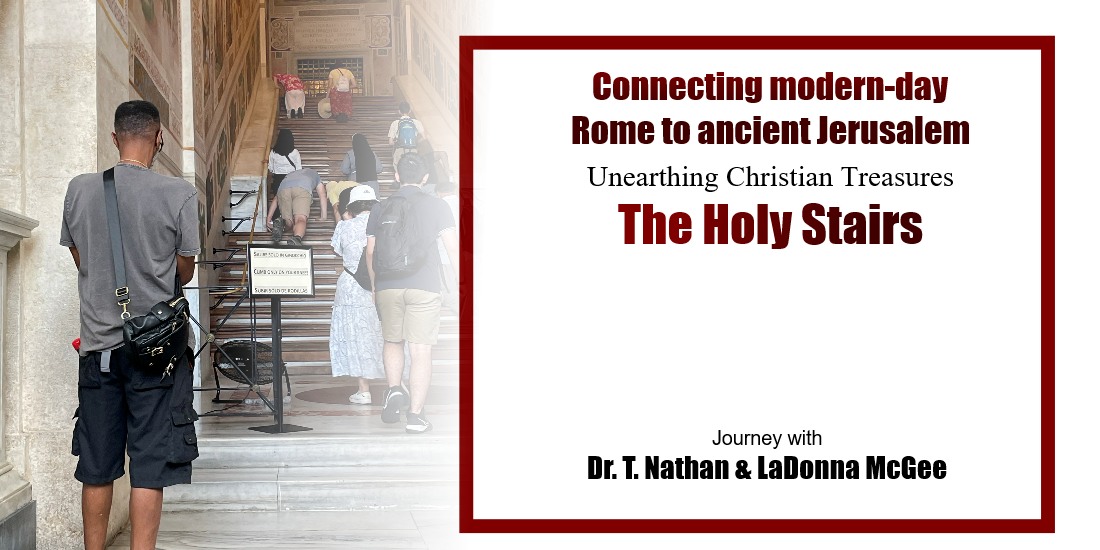
In the heart of Rome my wife and I, just steps from the magnificent Archbasilica of Saint John in Laterano, lies one of Christianity's most sacred treasures: the Scala Sancta, or Holy Stairs. These 28 white marble steps aren't just any staircase - they're believed to be the very steps Jesus climbed during his trial before Pontius Pilate.
The stairs now rest within the Pontifical Sanctuary of the Holy Stairs, a building that's technically not part of Italy at all, but rather belongs to the Holy See. It's a remarkable piece of the old Papal Lateran Palace that's been preserved through the centuries.
What makes these stairs truly special is how they're used. Pilgrims don't simply walk up them - in fact, they can't. The original marble steps can only be ascended on one's knees, a practice that's both a form of penance and a profound act of devotion. For those who'd rather not tackle the knee-climb, there are replica staircases on either side.
At the top of this sacred ascent lies the Sancta Sanctorum, or Holy of Holies - once the private chapel of the early Popes. Known formally as the Church of Saint Lawrence in Palatio ad Sancta Sanctorum, this intimate space served as a personal sanctuary for the leaders of the Catholic Church, adding another layer of historical and spiritual significance to this remarkable site.
The story of the Holy Stairs reads like a remarkable thread woven through Christian history, connecting modern-day Rome to ancient Jerusalem. These aren't just any steps - tradition holds they're the very stairs Jesus climbed during his trial before Pontius Pilate, their marble surface witnessing one of history's most pivotal moments.
Saint Helena, mother of Emperor Constantine the Great, reportedly brought them from Jerusalem around 326 AD. During the Middle Ages, they became known simply as the Scala Pilati - Pilate's Stairs - a name that echoed their solemn origin.
Their current home wasn't their first. Originally, these steps led to a corridor in the old Lateran Palace, near the Chapel of Saint Sylvester. But in 1589, when Pope Sixtus V found the palace crumbling, he ordered a complete overhaul. The stairs were carefully moved to their present spot, leading to the Sancta Sanctorum - a chapel that houses some of Catholicism's most precious relics, including a mysterious icon of Christ supposedly started by Saint Luke and completed by an angel.
Time and devotion have left their mark. Countless pilgrims ascending on their knees - the only way one is permitted to climb the original stairs - had worn the marble so smooth that in 1724, Pope Benedict XIII ordered them covered in wood for protection. For nearly three centuries, the original marble remained hidden beneath this wooden shield, only briefly revealed in 2019 during restoration work.
Today, four additional staircases flank the sacred steps, added around 1589 for everyday use. But the original stairs remain a powerful symbol of faith and remembrance, drawing pilgrims who seek to trace the footsteps of Jesus during his final hours.