
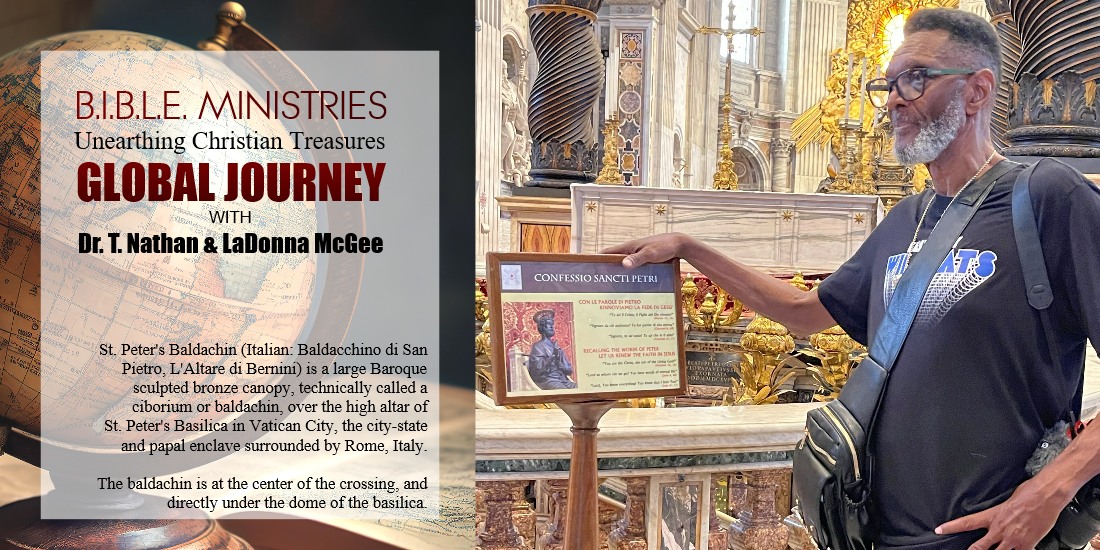
St Peter's Death Vatican Hill
As my wife and I continued our quest to explore the Christian connect of Rome it truly took us by surprise. We visited the St. Peters Basilica. Beneath the grand marble floors of St. Peter's Basilica lies one of Christianity's most profound archaeological mysteries - the tomb of Saint Peter himself. What began as a humble grave on the Vatican Hill has evolved into a complex archaeological site that continues to yield fascinating discoveries about the early Christian church.
According to ancient tradition, Peter was martyred during Emperor Nero's persecution of Christians around 64-67 AD. He was buried in a simple grave on the southern slopes of the Vatican hill, facing the circus where many Christians met their fate under Nero's reign. About a century after Peter's death, a modest memorial structure, known as a trophy or aedicula, was erected over the burial site - a fact recorded by a Roman priest named Gaius around 200 AD.
The story took a dramatic turn in the 4th century when Emperor Constantine, after converting to Christianity, ordered the construction of the first St. Peter's Basilica between 326 and 333 AD. To create a foundation for this massive church, Constantine's workers had to level the Vatican Hill, filling in an entire necropolis - a "city of the dead" that lay 5 to 12 meters below today's basilica. Despite this extensive construction, great care was taken to preserve what was believed to be Peter's original burial site.
Modern archaeological investigation of the tomb began in 1939, when Pope Pius XII secretly ordered excavations beneath the basilica. The discoveries were remarkable. Archaeologists uncovered an entire Roman necropolis, with tombs dating from the 1st to the 4th century AD. Near what is now the high altar of the basilica, they found evidence of the early memorial to Peter, along with a complex series of graves and structures that had been built and modified over the centuries.
Perhaps the most significant breakthrough came in the 1960s, when archaeologists discovered a set of bones in a wall near the original tomb site. After careful analysis, these remains were found to belong to a robust male, approximately 60 to 70 years old at the time of death. Based on these findings, Pope Paul VI made a solemn announcement in 1968 declaring that the relics of Saint Peter had been identified.
Today, the Vatican Necropolis, often called the Scavi (Italian for "excavations"), lies hidden beneath the modern basilica. The ancient burial ground contains about twenty mausolea, their walls still adorned with pagan and early Christian artwork. The tomb of Peter remains the heart of this underground complex, marking the spot where, according to two millennia of tradition, the first pope was laid to rest.
Visitors today can descend into this underground world through carefully regulated tours, walking the same paths that wind through this ancient cemetery. The experience offers a unique glimpse into the Roman world where Christianity first took root, and where one of its most important figures found his final resting place.
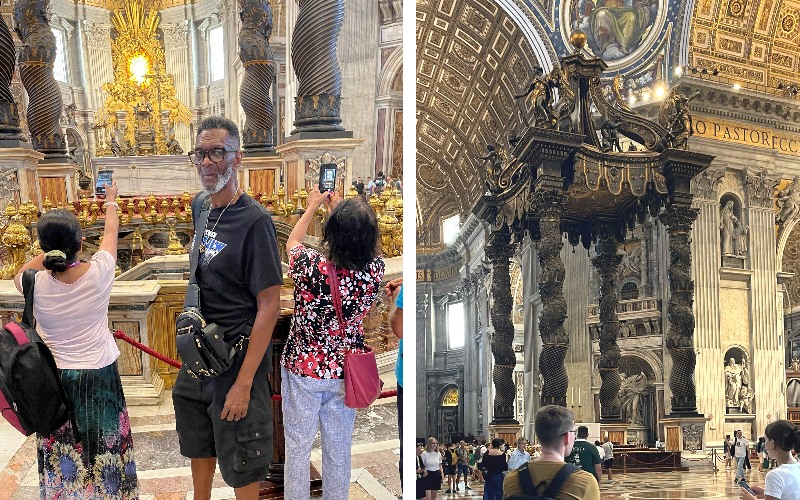
St Peter's Death Vatican Hill
The first mention of Saint Peter's death is in a letter from Rome's Bishop Clement to the Corinthians (1 Clement, also known as the Letter to the Corinthians, written in or around 96 AD). According to the much earlier theologian Origen, who passed away in 254 AD, Peter "came to Rome, and was crucified with his head downwards," according to the historian Eusebius, a contemporary of Constantine. Many religious imagery, fresco's, artwork, painting symbols typically shows St. Peter being crucified with his head pointing downward.